George Wray
The 1847 Barton Market Place Wife Sale: The Story of the Real George Wray
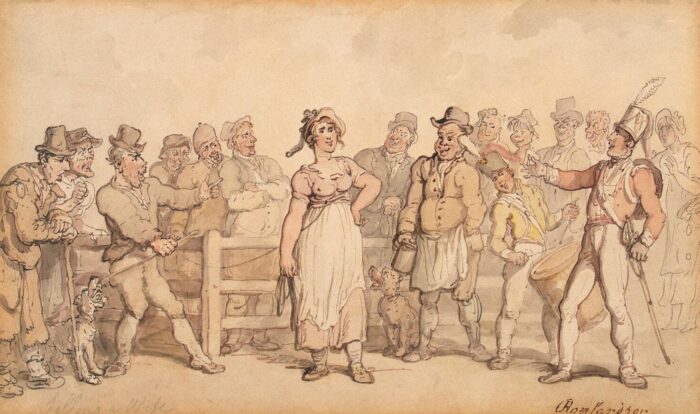
While local folklore in North Lincolnshire has long confused the traditional folk singer George Wray with a notorious 1847 marital scandal, archival records paint a fascinatingly distinct picture of the actual protagonist. The man who truly led his wife into Barton Market Place by a halter was an older, separate namesake, George Wray, an agricultural labourer from the neighbouring village of Barrow-upon-Humber.
The Logic Behind a “Poor Man’s Divorce”
In April 1847, the legal system in Victorian England offered no accessible way out for working-class couples trapped in broken marriages. A formal divorce required a costly Act of Parliament, an exorbitant luxury completely out of reach for seasonal labourers earning mere shillings a week.
In response, rural communities relied on an ancient, semi-legal folk custom: the public wife sale. While shocking by modern standards, the ritual was treated by the 19th-century working class as a consensual, highly structured contract. For the separation to be deemed socially binding, it had to mimic a legitimate livestock transaction. It required a public venue, a formal announcement, the payment of market tolls, and the symbolic use of a halter.
The Events of April 1847
Because the tiny village of Barrow lacked its own chartered market square, George Wray had to travel two miles down the road into the bustling market town of Barton-upon-Humber to carry out the ritual. According to regional newspaper reports in the Stamford Mercury, the events unfolded with immense public theatre.
The Public Cry
Punctually at 11 o’clock on a Wednesday morning, the town crier, Abraham Charlesworth, was the official Town Crier for Barton-upon-Humber. He marched through Barton, loudly announcing that the wife of George Wray of Barrow was being put up for public auction at the edge of the pig market.
The Market Transaction
A large, curious crowd gathered as George led his wife into the square by a new hemp halter tied around her waist. Bidding opened, but the auction was entirely pre-arranged. The woman was quickly knocked down to a local river boatman (a waterman) named William Harwood. The final purchase price was settled at one shilling and three-and-a-half pence (1s.3½d.).
The Peaceful Aftermath
Far from an act of cruelty or domestic malice, the newspaper reports suggest that the transaction was entirely mutual. Once the halter was handed over to Harwood, completing the symbolic transfer of custody, the small sum of money was immediately taken to a nearby public house. The newspaper reported that the money was returned to the buyer in the form of ale, and all three parties – George Wray, his former partner, and her new companion – sat together in high spirits to drink and celebrate the peaceful dissolution of the old union.
The Legacy of the “Two Georges”
This older George Wray effectively achieved his goal: the community recognised the sale, the couple parted ways permanently, and the woman later testified in local court matters as living independently. However, because working-class labourers frequently moved between Barrow and Barton for seasonal kiln work and agricultural employment, his colourful marketplace infamy eventually drifted.
Over the subsequent decades, as memories of the older labourer faded, the townspeople attached the legendary market-square story to Barton’s most prominent, visible, and celebrated namesake, George Wray of 35 Newport. It took modern genealogical cross-referencing of parish records to finally separate the two men, restoring the 1847 halter to the older Barrow labourer where it truly belonged.